




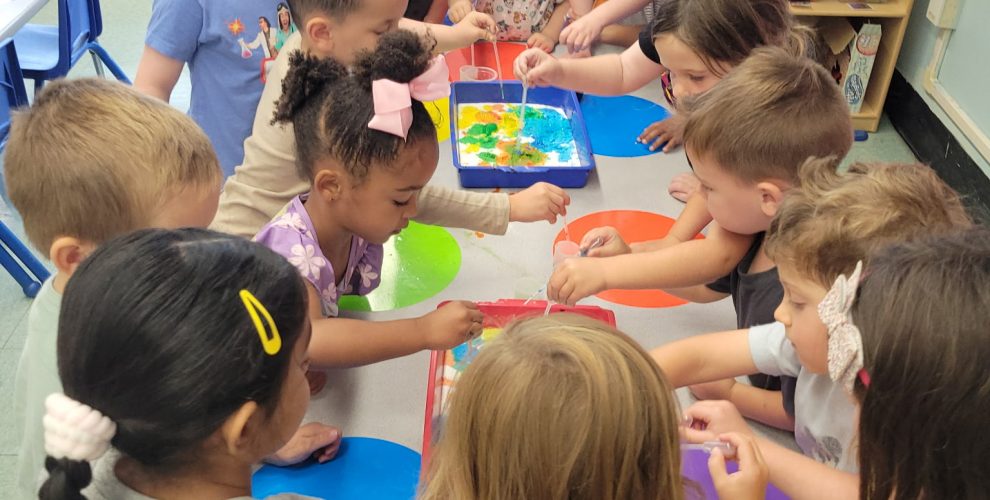
Children explore scientific concepts through questions, observations, and experiments.
They learn to make predictions, test hypotheses, and draw conclusions in simple, age-appropriate ways. For example, a teacher might ask, “What will happen if we mix water with sand?” and guide children to explore the outcomes.
Science activities emphasize rich language use—children talk through their observations, describe processes, and share findings. This helps develop vocabulary related to scientific concepts and supports cognitive skills like working memory and reasoning. You may hear our students talk about how things look (shiny, bright, dull, sparkly), how they smell (sweet, sour, flowery, tasty), or how they feel (soft, hard, scratchy, squishy, cold).
Before starting a science activity, children are encouraged to plan what they will do, breaking the task into steps. They practice following the plan, controlling impulses to stay on task, and revising the plan if needed.
Science concepts are often incorporated into dramatic play scenarios (pretending to be doctors, gardeners, or builders). This imaginative play helps children apply scientific ideas in context, fostering both creativity and critical thinking.
Activities include exploring natural materials (water, plants, rocks), simple experiments, and sensory experiences. These experiences promote observation skills and curiosity about the natural world.
Some fun activities you may see around our school include:
- Volcanos (baking soda and vinegar)
- Color mixing with paint
- Bridge building with toothpicks and marshmallows
- Planting seeds
- Exploring apples and pumpkins